Production Readiness
The Day Your MVP Became Something You Couldn't Afford to Lose
The architecture may look the same, but everything changes once customers, real data and payments depend on the product. This is the point where an MVP stops being disposable.
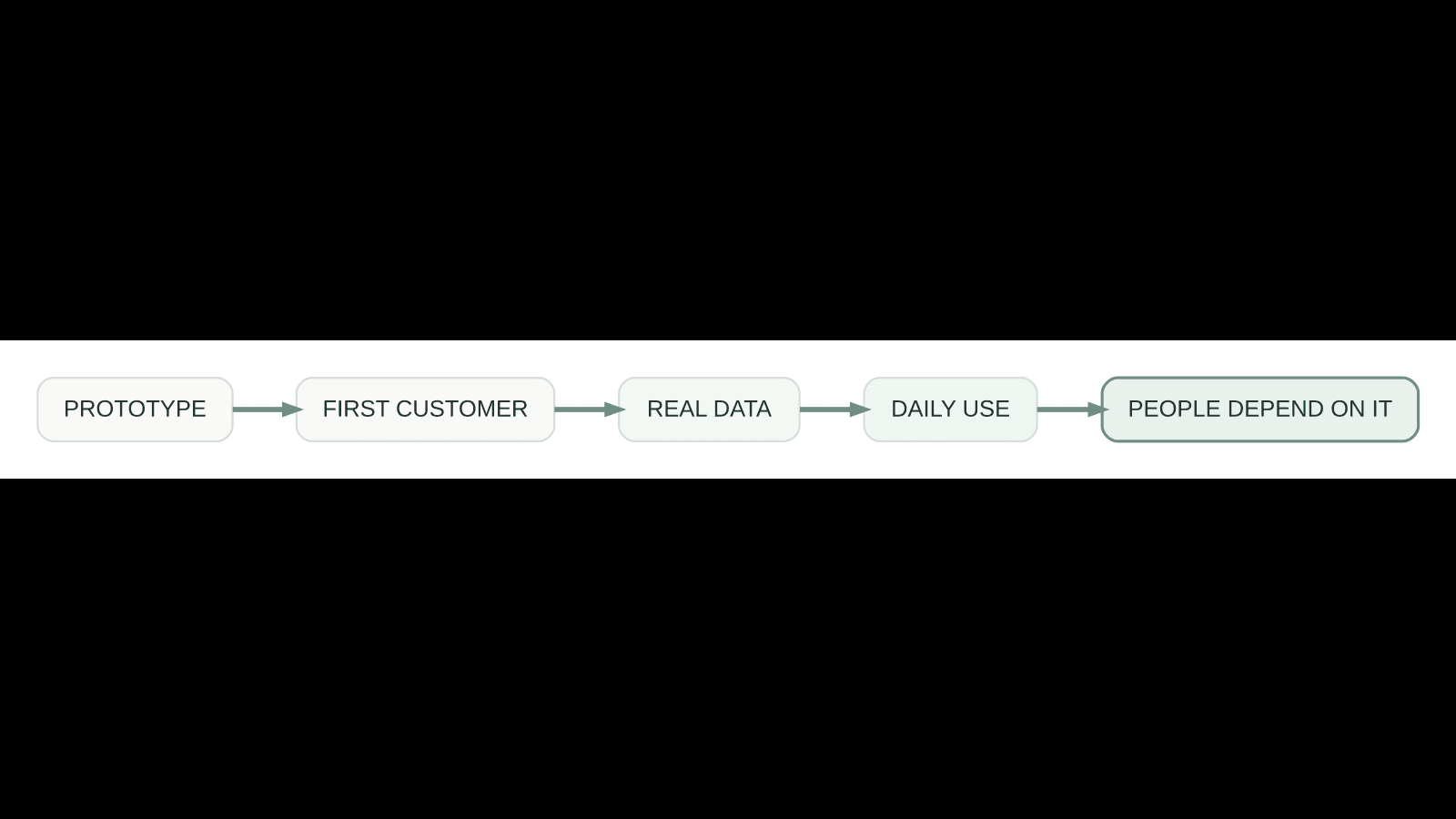
When the app stops being disposable
At the beginning, losing your app would be annoying.
You could probably rebuild it.
There were a few test users. Some fake data. Maybe a Stripe test account. Most of the important decisions still lived in your head.
Then something changes.
Someone pays you.
A customer uploads something they cannot recreate.
A team starts using the product every morning.
Someone messages you because the app is not working.
And almost without noticing it, your experiment becomes something people depend on.
That is one of the most important transitions in building software.
And it has almost nothing to do with how polished the UI looks.
The product may look exactly the same
One of the strange things about this stage is that visually, nothing dramatic has to happen.
Yesterday, you had an app built with Lovable, Replit or another modern builder.
Today, you still have the same app.
But yesterday losing the database meant losing test data.
Today it might mean losing a customer's work.
Yesterday a broken deployment meant waiting until tomorrow.
Today somebody may be paying you to use the product.
The architecture has not necessarily changed.
The consequence has.
That is the Production Gap.
“But my code is in GitHub”
This is often the first reassurance founders reach for.
And putting the code in GitHub is absolutely sensible.
But it can create a false sense that the whole business has now been backed up.
The repository may contain your application code.
It may not contain your:
- customer data;
- uploaded files;
- authentication configuration;
- payment webhooks;
- environment secrets;
- production database state;
- domain settings;
- deployment configuration.
Your code may be portable while the business state is not.
That distinction matters far less while the application is disposable.
It matters enormously once customers depend on it.
This is showing up in real founder conversations
In the shared research behind this piece, we reviewed a convenience sample of 10 recent public Replit and Lovable founder/builder discussions focused on real or near-production apps.
9 of the 10 discussions explicitly mentioned at least one of production data, environments, portability, migration or infrastructure control.
That does not mean 90% of AI-built applications have this problem.
It tells us something more useful:
Founders are reaching a stage where the question stops being:
“Can I build this?”
and starts becoming:
“Do I understand what I am now responsible for?”
The moment your MVP becomes a business
There is no universal milestone.
It might be:
- your first paying customer;
- your first hundred users;
- your first important upload;
- your first employee depending on the dashboard;
- or simply the first time you think: “If this disappeared tomorrow, I would have a serious problem.”
That is when the operating model needs to mature.
Not necessarily the technology.
You do not suddenly need Kubernetes.
You do not need to abandon the tool that helped you reach this point.
You do not need to rebuild everything “properly.”
You do need to understand what the business now depends on.
A useful founder question
Forget infrastructure terminology for a moment.
Ask:
If the platform I built this on became unavailable tomorrow, what would I actually lose?
The interface?
Probably not. You may have the code.
But what about:
- customer records;
- uploaded files;
- authentication;
- payment configuration;
- your domain;
- the ability to deploy?
The answer tells you much more about the maturity of the product than whether the frontend was hand-coded or AI-generated.
The real transition
One of the biggest misconceptions around MVPs is that the next stage is simply:
more features.
Often the next stage is actually:
more responsibility.
Responsibility for customer data.
Responsibility for uptime.
Responsibility for access.
Responsibility for knowing what is running.
Responsibility for recovering when something goes wrong.
That is what changes when the product becomes real.
And it is why the gap between building software and operating software is much larger than it first appears.
The Production Gap view
The interesting question is not:
“What tech stack did you use?”
It is:
“When did you realise this wasn't just an MVP anymore?”
That is the conversation The Production Gap should keep exploring.
Sources
The research behind this article reviewed 10 public r/Replit and r/Lovable founder/builder threads from 11 Aug–10 Sep 2026 about real or near-production operations, deployment, migration, data access and platform reliability. 9 of 10 contained at least one operational-control theme. This is a discussion-level convenience sample, not a market prevalence estimate.
Representative sources:
- Lovable — “My MVP is up and running, what's next?”
- Replit — production confidence and portability
- Replit — moving a production app off-platform
- Lovable — production backend/auth reliability
- Lovable — migration to self-hosting
What's next for you?
If your MVP now has real users, data or payments, the next step is not automatically more features. Write down what people now depend on, what would be painful to lose, and which parts of the product you still do not fully understand. That is usually where the next stage of the product begins.
About the author

Adeel Ahmad, Founder | Technical Architect
Adeel Ahmad is a software architect and founder with 15+ years of experience spanning design, development and software architecture. Having worked across the full product lifecycle, he now focuses on the gap between building software and operating it in the real world — architecture, reliability, AI-assisted development and production engineering.
View LinkedIn profile